Two new articles published this summer capture the journey and insights from the ACES project, which I had the privilege to lead with colleagues and partners across Malaysia, Indonesia, and Vietnam. Together, we explored how playful design, frugality, and co-creation can open new possibilities for inclusive and sustainable education in resource-constrained contexts.

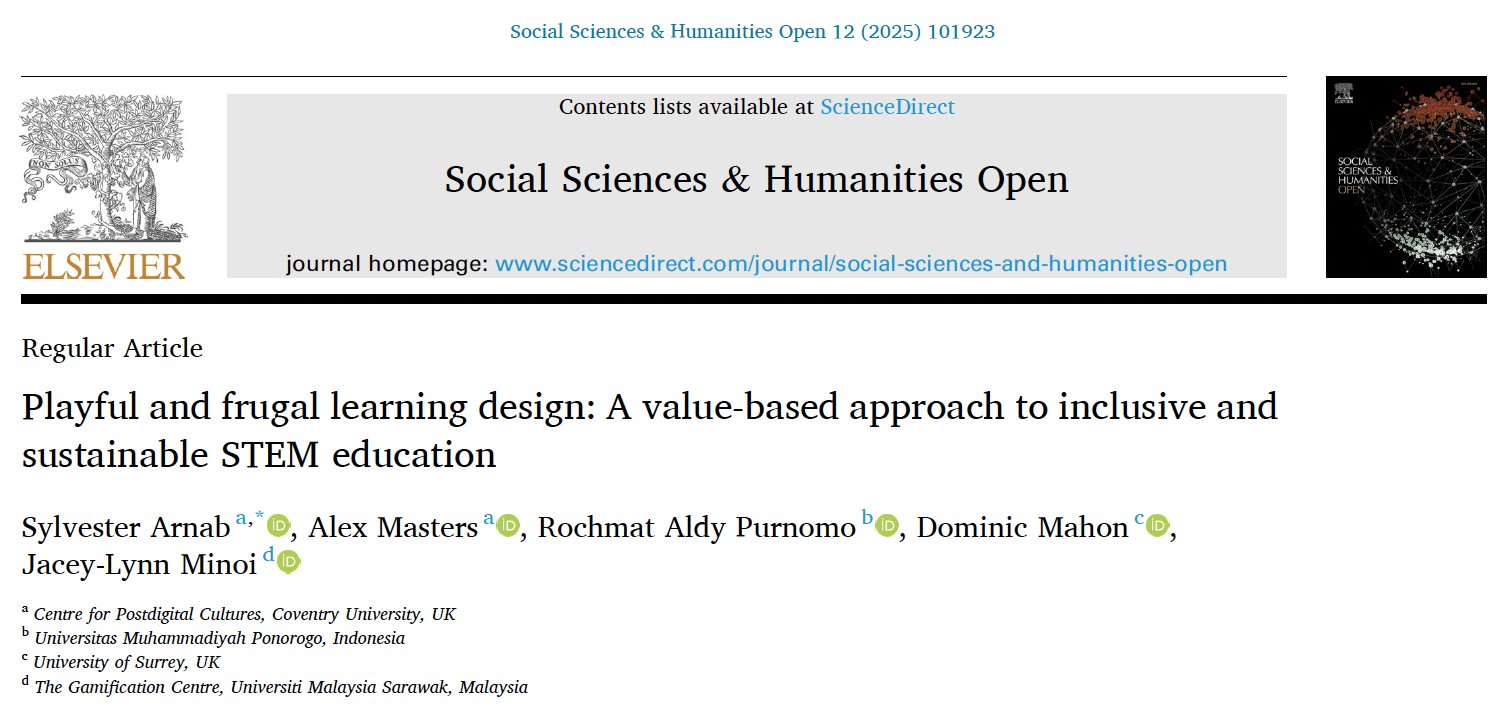
The first article, published in Social Sciences & Humanities Open (Elsevier), introduces a value-based framework for playful and frugal learning design. It shows how playful approaches, rooted in curiosity, creativity, and experimentation, can be combined with frugal innovation to make the most of locally available materials. This is particularly relevant in schools and communities where resources are scarce but where imagination and cultural knowledge are abundant. In practice, this meant designing STEM learning activities that were engaging, accessible, and contextually meaningful, while minimising costs and waste.
The second article, published in International Journal of Qualitative Methods (Sage), reflects on the methodological foundation of the project. Here, we situate our work within traditions of Community-Engaged Scholarship and Research (CES/CER), where communities are not passive recipients but active co-creators of knowledge. The paper presents a playful, frugal, and co-creative framework that guided our collaborations, ensuring that research outputs were shaped by, and valuable to, the communities themselves.
What emerges across both articles is a recognition that play, frugality, and co-creation are not separate strategies but complementary forces. Together, they enabled us to design learning experiences that were inclusive, culturally grounded, and sustainable, while also modelling ways in which research itself can be conducted in partnership with communities.
For me, these publications are not just academic milestones, they are reflections of the commitment, creativity, and resilience of the educators, researchers, and communities we worked with across Southeast Asia. The lessons extend well beyond ACES: they offer pathways for designing and researching education that is responsive, respectful, and transformative.
You can read the full articles here:
- Playful and Frugal Learning Design: A Value-Based Approach to Inclusive and Sustainable STEM Learning (Social Sciences & Humanities Open, Elsevier)
- Empathic and Agentic Approaches to Community-Engaged Research Scholarship: A Playful, Frugal, and Co-Creative Framework Through the ACES Project in Southeast Asia (International Journal of Qualitative Methods, Sage)

 Sylvester Arnab