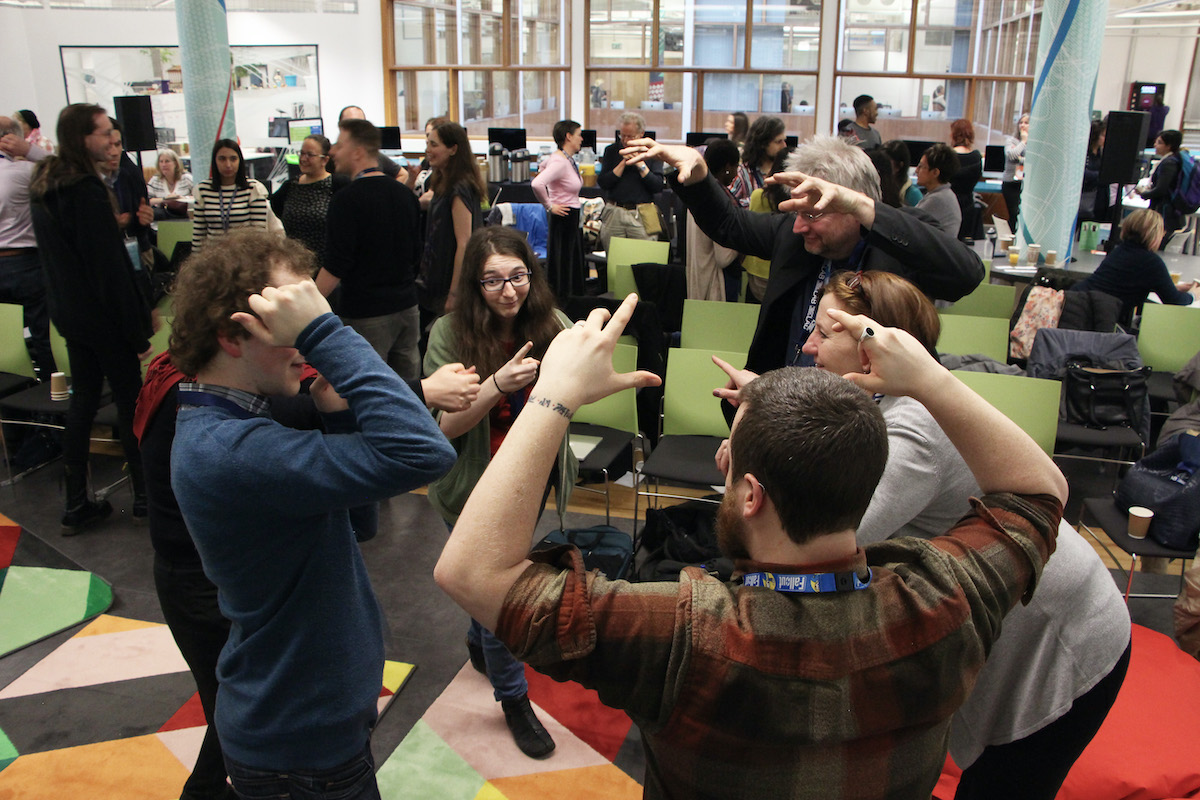
This morning, my iPhone reminded me that nine years ago today, we were hosting our very first RemixPlay.
A room alive with movement. People playing, laughing, debating, building, and discovering new ideas through hands-on experimentation with one another.
It was not the specific edition that struck me. It was the journey. Looking back, RemixPlay has quietly mapped the evolution of how we think about play, research, and community over nearly a decade. The idea for RemixPlay began while I was writing my blog post Re-Mixing Play in 2016, where I was exploring the notion of remixing as a creative and critical process, taking existing elements of play, reconfiguring them, and redesigning them with intentional purpose.
What started as an exploratory gathering has become a thread running through much of our work in playful and community-engaged design.
RemixPlay 1: Play as Serious Practice
RemixPlay 1 in 2017 set the foundation. The focus was clear: play deserves to be taken seriously in higher education and research.
Moving beyond “gamification”, “serious games” and “game based learning”, the Summit examined the playful roots and meanings of these approaches and provide an interdisciplinary discussion space to explore the opportunities that play and playfulness can provide for both learners and educators.
The event brought together academics, designers, technologists, and practitioners to test the boundaries between rigour and creativity. It was exploratory and conceptual, establishing play as a legitimate site of scholarly and professional inquiry.
RemixPlay 2: Co-Creativity and Community Engagement
RemixPlay 2 marked a shift from conceptual framing to collaborative practice.
The central focus was co-creativity. We asked:
What happens when playful design is developed with communities rather than for them?
How can co-creation shape educational, cultural, and social innovation?
The conversations centred on community-engaged approaches, participatory design, and shared ownership of playful initiatives. Rather than presenting finished research, participants worked through ideas together.
This edition strengthened RemixPlay as a space for collective imagination. It was less about presenting expertise and more about building it together.
Looking back, this was an important turning point. It foregrounded the values that have since shaped many of our international collaborations.
RemixPlay 3: Social Innovation and Playful Inspiration
RemixPlay 3 expanded the conversation into social innovation.
The emphasis moved towards how playful thinking can inspire change beyond formal educational settings. We explored:
- Play as a catalyst for social entrepreneurship
- Creative practice as a driver of community resilience
- Playful interventions in civic and cultural contexts
This edition was energising. It framed play not only as pedagogy, but as a force for reimagining social systems. Inspiration became a key theme. Participants shared how playful methods were being used to address real-world challenges.
The progression was clear. From serious inquiry, to co-creation, to social transformation.
RemixPlay 4: Global Dialogue and Adaptive Play
RemixPlay 4 took place during a period of disruption. The format adapted to more open and globally connected modes of engagement. We adopted an un-webinar approach, where case studies from 11 countries were featured asynchronously prior to the three live (online) events across three time zones.
The focus was on sharing international initiatives that demonstrated how play responds to uncertainty. Discussions centred on :
- Playful resilience
- Digital and hybrid experimentation
- Cross-cultural collaborations
Rather than being confined to one location, RemixPlay became more distributed. It highlighted that playful practice is not context-bound. It travels, adapts, and evolves.
RemixPlay 5: Change-Making and Agency
By RemixPlay 5, the emphasis shifted towards change-making. The question was no longer whether play works, but how it enables transformation.
We explored how playful design supports agency, inclusion, sustainability, and systemic change. Conversations connected directly to community-engaged initiatives, participatory design, and frugal innovation.
Many ideas that later matured into funded projects and international collaborations were seeded here.
RemixPlay had become more than an annual gathering. It was functioning as a living lab for experimentation and partnership-building.
The Most Recent RemixPlay: Sensors, Live Collaboration, Serious Outcomes
The most recent RemixPlay marked another significant shift.
Rather than centring broad conceptual themes, we focused on live initiatives already in progress. In collaboration with colleagues from Manchester Metropolitan University, the theme of sensors and play emerged directly from an active research partnership. The event was in Coventry and Manchester. This was the first time that RemixPlay was organised outside of Coventry University.
This was not speculative discussion. It was grounded in embodied experimentation. Heart rate as input. Biofeedback as mechanic. Responsive systems as research method.
The emphasis was on serious outcomes. How do physiological signals inform interaction design? How can playful sensor-driven systems support wellbeing, engagement, or behavioural insight?
By narrowing the focus to specific, community-driven areas, the event became more concentrated and dialogic. It felt less like a showcase and more like a collaborative research lab in action.
In many ways, this edition reflected the maturation of RemixPlay itself: from broad provocation to situated, live experimentation with tangible impact. This RemixPlay led to a journal article (currently in-press) on the Mapping of Serious Objectives, Game Mechanics, and Sensor Technologies as a co-design metholdology.
What Has Happened Since
Since that last edition, the work has continued internationally. RemixPlay is due for a comeback!
We have completed and advanced projects grounded in playful, community-engaged design across multiple countries. These initiatives have connected arts, science, education, and local communities.
One of the next milestones is the upcoming exhibition emerging from the AHRC-Funded FAiR project. This playful arts-science-community collaboration has produced tangible outcomes rooted in environmental storytelling, material practice, and co-creation with communities.
The exhibition will bring these outcomes into public space. It represents playful collaboration translated into visible, shared artefacts.
In many ways, it feels like the next logical step. From conversations, to collaborations, to co-created works that can be experienced by wider audiences.
Gratitude
RemixPlay has only ever been possible because of the people who shaped it.
To the speakers who shared emerging work.
To the playful innovators and educators who brought ideas into the room.
To collaborators from Coventry University and other institutions.
To community partners and participants, who trusted us to co-create.
Thank you.
Each edition has built on the generosity, openness, and critical engagement of its participants.
What Next?
Eight years on, RemixPlay has evolved from playful provocation to living practice.
Perhaps the next chapter is not simply another annual event, but deeper integration into exhibitions, embedded labs, and sustained international collaboration. We are now adapting our approach in South Africa! Watch This Space!
The format may continue to change. But the core remains:
Play is not ornamental.
It is methodological.
It is relational.
It is transformative.
And sometimes, a simple photo memory is enough to remind us how far that journey has travelled.

 Sylvester Arnab