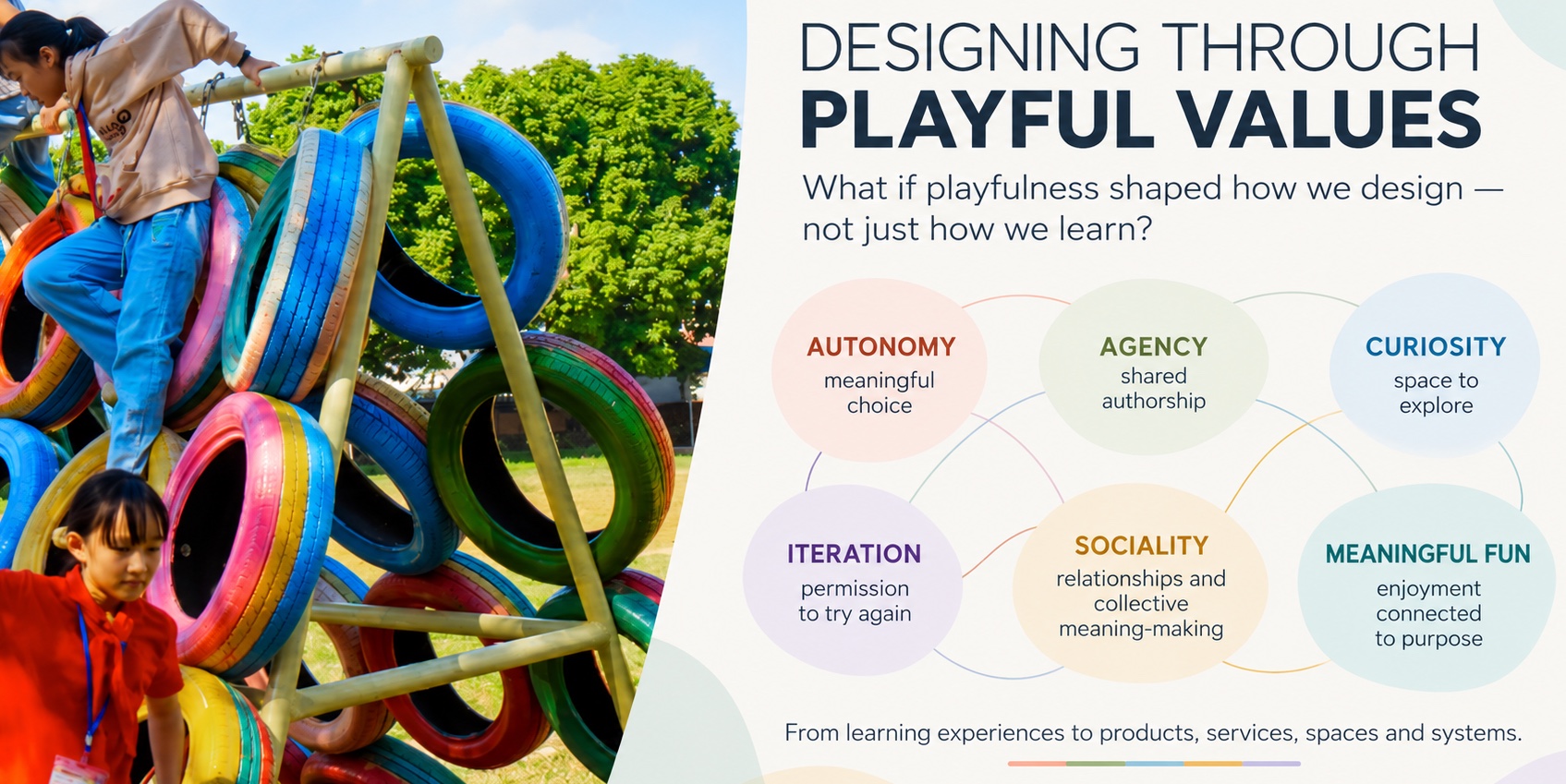
I have been thinking a lot recently about values-based design and, more specifically, what it might mean to approach design through the lens of playful values.
This is partly a reflection on work I have been involved in over a number of years, and partly me thinking aloud as I develop an article around what I am currently calling the Playful Values Design Framework.
The starting point is quite simple:
Design is never really neutral.
Whenever we design something: a learning experience, a product, a digital platform, a service, a community intervention, or even an organisational process, we make decisions about what people can do, what choices they have, whose voices matter, how they interact, what happens when something goes wrong, and what kinds of behaviours the system encourages.
Those decisions embody values.
This is certainly not a new argument. Fields such as Value Sensitive Design have long argued that human values need to be considered as part of technological and system design. Values at Play similarly demonstrated how values can become embedded in games through rules, mechanics, narratives, and interactions.
But I have been wondering about this from a slightly different direction:
Could playfulness itself provide a values-based orientation for design?
And, perhaps more importantly:
What changes when we stop thinking about playfulness as something we add to an experience and instead use playful values to shape how that experience is designed in the first place?
From playful learning to playful values
Much of my own thinking comes from work around playful learning, gameful design, and community-engaged practice.
Over the years, particularly through projects such as CreativeCultures and ACES , we explored how playful and frugal approaches could enable educators and communities in Indonesia, Malaysia, and Vietnam to create locally meaningful educational interventions.
What became increasingly interesting was that the important thing was not necessarily the presence of a game.
In fact, it often wasn’t about games at all.
It was about the conditions we were creating.
Were people able to make meaningful choices?
Could they influence what was happening rather than simply follow instructions?
Was there room to explore something without already knowing the answer?
Could an idea fail, change, and be tried again?
Could knowledge be created together?
And could the experience be enjoyable while still having genuine purpose?
Across this programme of work, I began articulating these ideas through six interconnected playful values:
Autonomy. Agency. Curiosity. Iteration. Sociality. Meaningful fun.
In earlier work, we explored how these playful dimensions related to learning, 21st-century competencies, resilience, and community-engaged educational practice; plus with regards to teacher-led development of STEM resources.
What I am now interested in is making a slightly different move:
What if these are not simply qualities of a playful experience? What if they are design commitments?
That distinction feels important.
Designing for autonomy rather than expecting autonomy
Take autonomy.
We can say that we value autonomy. But that doesn’t necessarily mean that the thing we design actually enables it.
A system might tell people they are empowered while giving them only one meaningful route through it. A learning activity might claim to be learner-centred while every question, resource, outcome, and assessment criterion has already been determined. A digital product might offer twenty options, while none of them gives the user meaningful control.
So perhaps autonomy as a design commitment means something more specific:
Have we designed meaningful choice into the experience?
The same applies to agency.
Agency is not simply inviting somebody to participate. It asks whether people can actually influence what happens.
Can they change the direction of an activity? Shape the outcome? Contribute something that was not anticipated by the designer? Create rather than merely consume?
That becomes particularly important in participatory and community-engaged work. There is quite a difference between designing something for a community and creating the conditions in which people can become co-authors of what emerges.
Curiosity means leaving some doors open
Then there is curiosity.
Design often rewards certainty.
We define the problem. We optimise the journey. We remove friction. We make the pathway clear.
And, of course, sometimes that is exactly what good design requires.
But curiosity needs something else: productive uncertainty.
It needs unanswered questions, possibilities, things to investigate, and occasionally a little ambiguity.
This is something we saw repeatedly through ACES and subsequently through initiatives such as STEMBucket, where everyday and accessible materials could become starting points for experimentation rather than instructions for reproducing a predetermined solution.
The resource wasn’t valuable simply because of what it contained. Its value also came from what it allowed somebody to do, change, question, combine, or create.
That idea seems relevant well beyond education.
A product can close down possibilities or invite exploration.
A digital system can dictate a workflow or enable people to appropriate it for their own purposes.
A public space can tell us implicitly how we are supposed to behave, or it can invite interpretation, interaction, and unexpected use.
Curiosity, viewed this way, becomes a design question.
Iteration means making room for things not to work
One of my favourite playful values is iteration.
Play gives us permission to try, permission to ‘fail’.
F.A.I.L is First.Attempt.In.Learning afterall. 🙂
And importantly, to try again.
That sounds obvious, but many of the systems we design are surprisingly unforgiving. They assume a relatively linear journey: understand → act → succeed.
Real life rarely behaves like that.
Designing through iteration means treating experimentation, feedback, adaptation, and revision as legitimate parts of an experience rather than signs that something has gone wrong.
In educational settings, that might mean giving learners opportunities to prototype, receive feedback, rethink, and remake.
In product design, it might mean enabling experimentation before commitment.
In organisations, it might mean creating processes where ideas can evolve rather than requiring them to arrive fully formed.
In community projects, it means recognising that the intervention we initially imagined may not be the intervention the community ultimately needs.
That last point has been particularly important in our community-engaged work.
Sociality: designing the relationships, not just the thing
Another lesson from projects such as ACES, STEMBucket, and more recently our FAiR and FAiR4All work around environmental art, science, and community engagement is that we are rarely designing only an artefact or activity.
We are also designing conditions for relationships.
This is where sociality becomes important.
Who gets to speak?
Who gets heard?
Whose knowledge counts?
Who creates?
Who decides?
What opportunities exist for people to learn from one another?
Sociality is therefore more than putting people into groups or adding a collaborative feature to a platform. It is a commitment to creating the conditions for dialogue, reciprocity, shared participation, and collective meaning-making.
And there is an important caution here.
Collaboration does not automatically mean inclusion.
A system can be highly collaborative while reproducing existing power relationships. Designing for sociality therefore also requires us to pay attention to whose participation is being enabled and whose may inadvertently be constrained.
And then there is meaningful fun
I deliberately use meaningful fun, rather than simply fun.
Because fun for its own sake is not always the point.
Nor am I arguing that everything should become a game.
Meaningful fun is about creating experiences where enjoyment, imagination, challenge, creativity, experimentation, and social interaction connect to something people actually care about.
Sometimes that might involve a game.
Sometimes it might involve making something together.
Sometimes it might be the satisfaction of solving a difficult problem, discovering something unexpected, creating an artefact, changing a place, or seeing an idea that began as a slightly ridiculous sketch actually work.
The important thing is the relationship between enjoyment and purpose.
This is also why I think playful values offer something different from simply “gamifying” an experience. Points, badges, rewards, and competition may be playful mechanisms in some circumstances, but they tell us very little about whether the underlying experience supports autonomy, agency, curiosity, iteration, or meaningful social participation.
Something can look like a game and be profoundly unplayful.
Equally, something can contain no recognisable game mechanics whatsoever and still be deeply playful.
From activities to resources, spaces – and perhaps systems
In the article I am currently developing, I explore these six values across three interconnected aspects of educational intervention: resources, activities, and spaces.
Resources shape what people can engage with.
Activities shape what people can do.
Spaces shape where, with whom, and under what conditions participation happens.
Importantly, these do not operate separately. They form an ecology. A beautifully open-ended activity can still constrain agency if the resources are fixed. An adaptable resource does little for autonomy if the activity prescribes exactly how it must be used. And both can struggle if the surrounding environment makes people feel that experimentation or questioning is unsafe.
This is where I am beginning to wonder whether the argument has relevance considerably beyond education.
Perhaps we could ask similar questions when designing products, services, technologies, organisations, public spaces, or complex systems.
For example:
Does the product provide meaningful choice, or simply more options?
Can users shape the system, or only operate within choices already made for them?
Does the service invite curiosity and exploration where appropriate?
Can people experiment, make mistakes, and recover?
Does the system facilitate meaningful relationships and collective action?
And does engagement feel worthwhile, satisfying, perhaps even joyful, because it connects to something meaningful?
These are not necessarily questions about making design more entertaining.
They are questions about what kind of human experience our designs make possible.
Playful values are not a checklist
There is another important part of this idea that I am still exploring.
These six values cannot simply become another checklist.
Autonomy is not always good in unlimited quantities. Too much choice can overwhelm.
Agency involves responsibility and can conflict with organisational requirements.
Curiosity can conflict with efficiency.
Iteration requires time and tolerance for uncertainty.
Sociality raises questions of power and equitable participation.
And fun is culturally and contextually situated: what is meaningful and enjoyable to one person or community may not be so for another.
So designing through playful values also means negotiating tensions.
That may actually be one of the most useful aspects of thinking about them as design commitments.
They make those tensions visible.
Rather than asking, “Have we included autonomy?”, we can ask:
How much autonomy is appropriate here, for whom, and where does structure become necessary?
Rather than asking whether something is collaborative:
Who actually has agency within that collaboration?
Rather than asking whether an experience is fun:
What makes participation meaningful to the people involved?
Those are much richer design conversations.
Where I am heading with this
These thoughts are part of an article I am currently developing around what I am calling the Playful Values Design Framework (PVDF). I know I know – this sounds like MDF or something – but I’m working on it! 🙂
The academic paper is situated primarily within educational design and builds on our research across ACES, STEMBucket, FAiR, and related work. But writing it has made me increasingly interested in the broader proposition.
Perhaps the real potential of playful design isn’t simply in designing games, or even in making experiences more playful.
Perhaps it lies in using the values of playfulness as commitments for how we design.
Autonomy asks us to design meaningful choice.
Agency asks us to share authorship.
Curiosity asks us to leave room for questions and discovery.
Iteration asks us to make experimentation and revision legitimate.
Sociality asks us to design for relationships and collective meaning-making.
Meaningful fun asks us to connect enjoyment with purpose.
Together, they offer a way of thinking about design that is participatory, adaptive, relational, and open to possibility.
I am still developing this argument and that is partly why I wanted to write this post.
It is a sketch of an idea rather than a finished framework carved in stone.
Which, perhaps appropriately, means it is itself open to curiosity, dialogue, and iteration.
And I would be genuinely interested in how these ideas resonate beyond education.
What would it mean to design your product, service, technology, organisation, intervention, or system through playful values?
And perhaps the more interesting question:
What might you design differently if you did?


