When we began ACES in 2020, we could not have anticipated quite how central the idea of resilience would become to the project.
ACES – A Community-Centred Educational Model for Developing Social Resilience – brought together partners and communities across Indonesia, Malaysia, and Vietnam to explore how playful, frugal, and co-creative approaches to education could contribute to individual, community, and institutional resilience. Running from 2020 to early 2023, and funded by UKRI-ESRC through the Global Challenges Research Fund, it was conceived around equitable and inclusive education, community participation, and the development of approaches that could respond meaningfully to different local contexts.
Then COVID-19 happened.
Suddenly, resilience was no longer simply something we were researching. It was something that we, our partners, educators, learners, and communities had to practise.
Plans changed. Spaces changed. Travel became impossible. Access to technology varied considerably. Educators had to rethink how they engaged learners. Communities had to find ways of continuing educational activities with whatever resources and connections were available.
In many ways, the project itself began to embody the very ideas it was investigating: absorbing disruption, adapting to changing circumstances, and sometimes transforming practices altogether. These eventually became important ways in which we understood resilience within ACES – as absorptive, adaptive, and transformative, and importantly, as an ongoing process rather than simply an outcome.
Looking back several years later, however, what stays with me most about ACES is not a particular activity, toolkit, or intervention.
It is a way of thinking about how educational change happens.
Starting with communities, not solutions
Research projects can easily begin with an intervention.
We identify a problem, develop something that might address it, and then find a context in which to implement and evaluate it.
ACES increasingly challenged us to think differently.
Instead of asking:
What can we deliver here?
we found ourselves asking:
What already exists here? Who understands this context? What matters to this community? What resources, knowledge, relationships, and capabilities are already present? And what might we create together?
This distinction became increasingly important.
The ACES Charter, which emerged from our collective learning across the project, emphasises that universities can play an important role as anchor institutions, but that this should not mean dictating the relationship. Trust takes time. Relationships need to be nurtured. Communication needs to work in both directions. Most importantly, the university needs to work with communities rather than for them.
For me, this remains one of the most important lessons from ACES.
Meaningful educational innovation rarely begins with the intervention.
It begins with relationships.
Four principles that emerged from ACES
As we reflected across the work taking place in three countries, four interconnected principles became increasingly visible:
Community. Playful. Frugal. Co-creation.
These became the foundation of the ACES Charter: A Community-Centred Educational Model for Developing Social Resilience Through Play.
The Charter describes these as community-centred values for collective action; playful values for intrinsic motivation and meaningful engagement; frugal values for creative, practical, and sustainable design; and co-creation values for equitable problem solving.
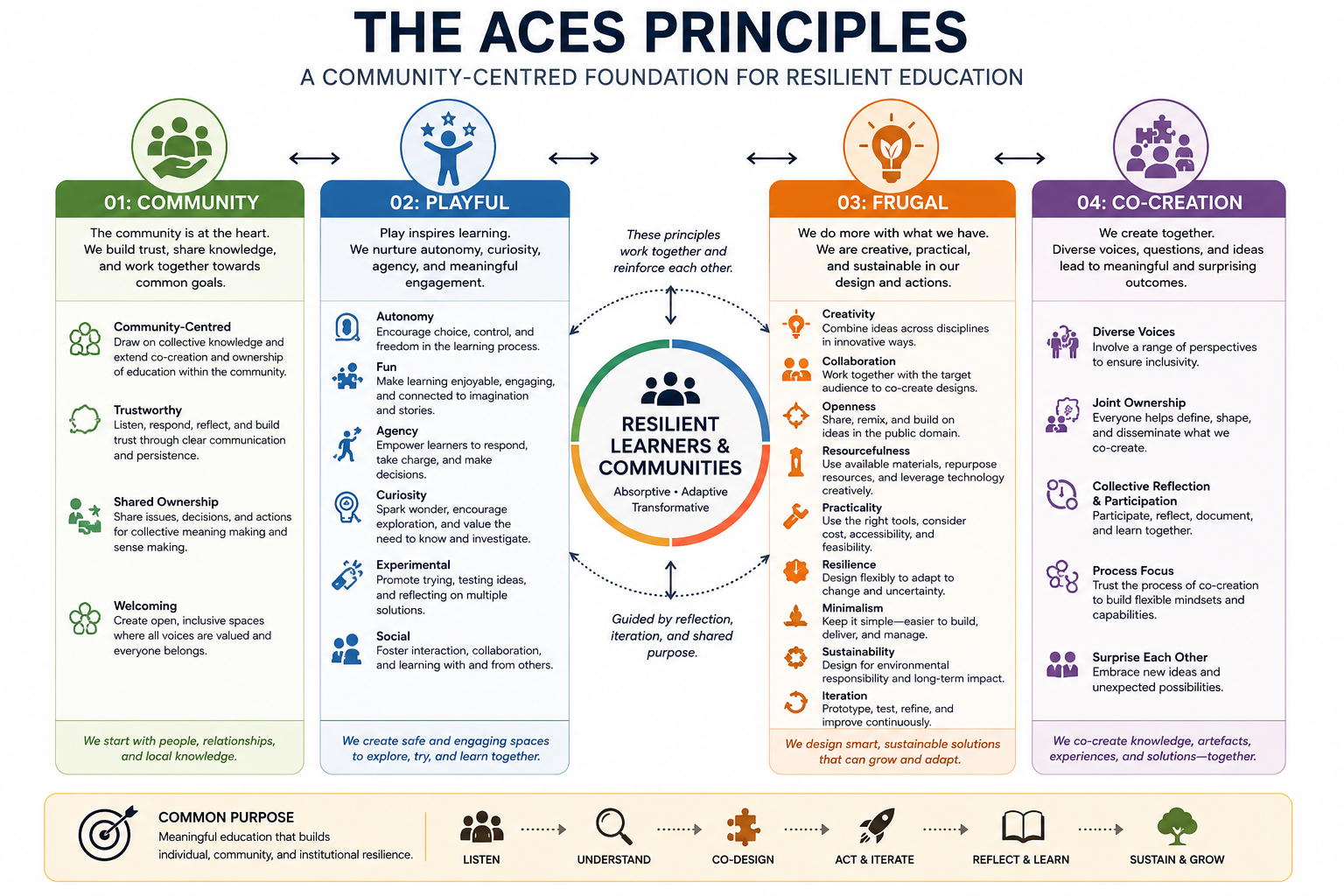
But I increasingly see them not as four separate components of a framework, but as values that reinforce one another.
Community: change starts with people
Being community-centred means recognising that knowledge and expertise already exist within communities.
ACES taught us about the importance of trust, listening, shared ownership, belonging, and creating welcoming spaces in which different voices can contribute. The Charter therefore emphasises collective knowledge and experience, shared decision-making, shared action, and reflection rather than positioning communities simply as recipients of an educational intervention.
It also changed how we thought about educators.
An educator does not have to be a classroom teacher. An educator might be an academic, NGO worker, volunteer, parent, community leader, or even a young person. These individuals can become change agents and community brokers, connecting educational activity with local priorities and mobilising others around opportunities for change.
Playful: giving people permission to experiment
Playfulness in ACES was never simply about making education more entertaining.
It was about creating conditions for autonomy, agency, curiosity, experimentation, meaningful fun, and social interaction.
Play gives us permission to ask what if?
It allows learners and educators to try something, make choices, test possibilities, fail safely, modify an idea, and try again.
That matters for resilience because uncertainty cannot always be addressed by following an existing set of instructions. Sometimes people need the confidence and space to imagine alternatives.
The Charter describes these as opportunity spaces and safe spaces – environments in which educators and learners have permission to experiment and recognise learning as iterative and incremental.
Frugal: innovation does not have to be expensive
Another important lesson from ACES was that innovation should not automatically mean introducing more technology, more equipment, or more resources.
Sometimes innovation begins by looking differently at what is already around us.
Frugal values encourage resourcefulness, practicality, creativity, openness, minimalism, sustainability, resilience, collaboration, and iteration. The principle is wonderfully straightforward: start with what is available, keep things as simple as they need to be, prototype, test, learn, and improve.
This was particularly important when working across contexts where resources, infrastructure, and access could vary enormously.
A sophisticated educational intervention that cannot be maintained after a research project finishes is not necessarily more innovative than something simple that a teacher or community can adapt, reproduce, and sustain.
Co-creation: don’t arrive with the answer
Co-creation completes the picture.
It asks us to involve different voices not only in evaluating what researchers have created, but in shaping the questions, experiences, resources, and solutions themselves.
Importantly, ACES also taught us that co-creation does not have one fixed form. People can design, contribute insights, contextualise, remix, appropriate, challenge, and even choose not to participate. The Charter therefore emphasises joint ownership, collective reflection, participation, process, and openness to unexpected outcomes.
And that last point matters.
If we genuinely co-create, we cannot already know exactly what the outcome will be.
Playfulness creates permission to experiment. Frugality makes experimentation possible with what is available. Co-creation ensures that solutions are not simply imposed. Community-centredness keeps the process grounded in the people, relationships, and places that ultimately need to sustain it.
We also discussed these principles within the context of Community-Engaged Research Scholarship (CERs) in this published article.
From principles to a project-based approach
One thing we particularly wanted the ACES Charter to do was move beyond describing values and provide something that others could actually use.
This became the ACES Process – a project-based approach to community-led educational development.
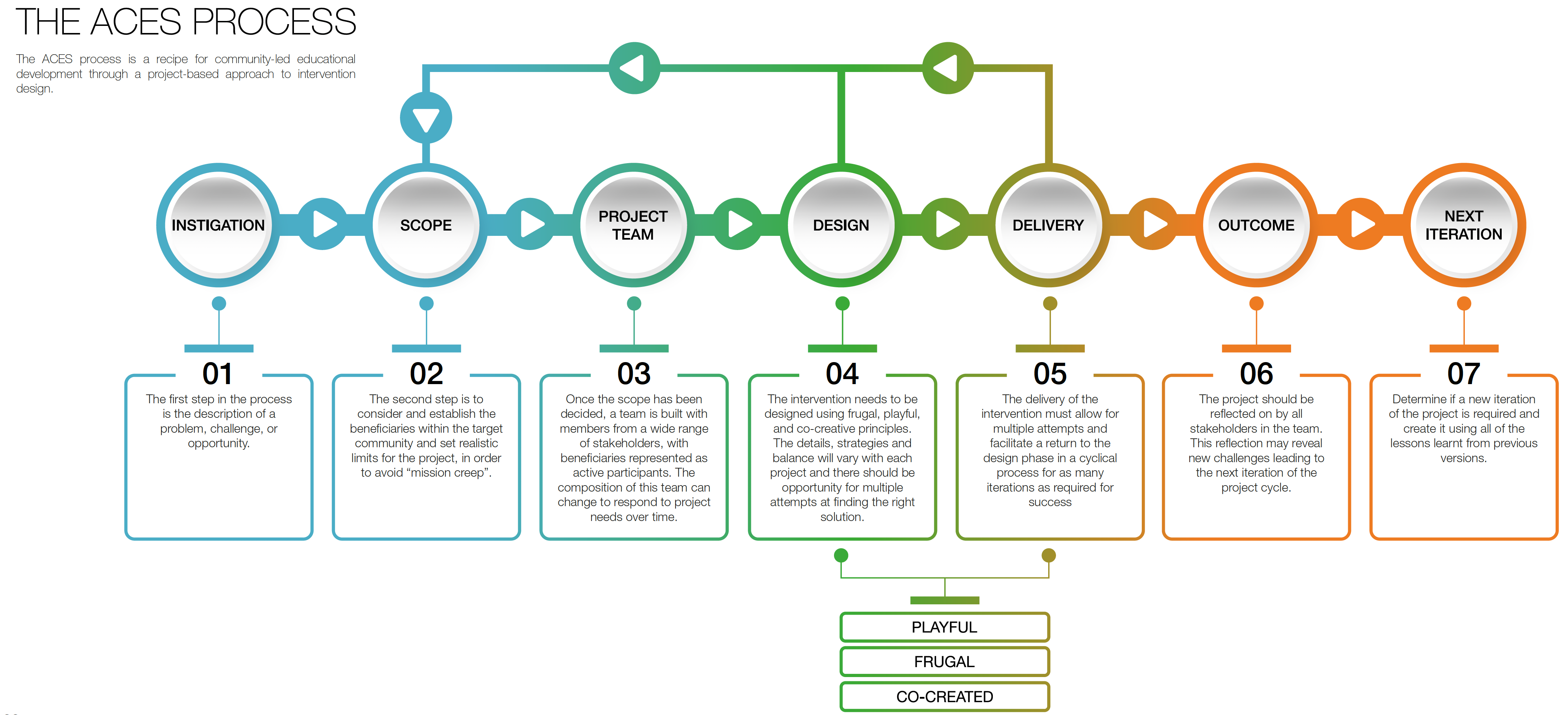
The starting point is deliberately not a technology or educational resource. It is a problem, challenge, or opportunity.
From there, the process asks us to identify the community and intended beneficiaries and establish a realistic scope. A team is then formed involving a broad range of stakeholders, importantly with beneficiaries represented as active participants.
Only then is an intervention designed, drawing upon playful, frugal, and co-creative principles.
But the process does not stop at delivery.
Interventions should allow multiple attempts. Delivery can take us back into design. Stakeholders reflect together on what happened, what was learned, and what new challenges or opportunities have emerged. Those insights then inform another iteration where appropriate.
The Charter describes this as:
“a recipe for community-led educational development through a project-based approach to intervention design.”
Perhaps the most important word here is not project, but process.
ACES was never intended to produce a rigid methodology that could simply be transported from one community to another.
In fact, one of its key insights was precisely the opposite: rather than providing a tightly bound structure, ACES offers principles and values that create space for agency, creativity, and community choice because there is no one-size-fits-all solution.
The principles travelled; the solutions did not
The differences between what emerged in Malaysia, Indonesia, and Vietnam demonstrate this particularly well.
In Malaysia, ACES connected with the CreativeCulture ecosystem and supported initiatives such as STEMBucket and the PlayLab Bus, bringing playful, frugal, and co-creative approaches into STEM learning and educator development.
In Indonesia, the work connected universities, policymakers, NGOs, educators, volunteers, parents, local authorities, and young people, including activities in informal educational spaces and community learning environments.
In Vietnam, communities co-created a Playful School Model, including the Green Playground, Frugal STEM, and activities connecting education with Muong language, culture, and local socio-economic contexts.
ACES therefore did not produce one intervention that was replicated across three countries.
It produced different expressions of a shared set of values.
That distinction matters.
What travelled across contexts was not a prescribed solution, but an approach to creating solutions.
Beyond ACES: when projects become platforms
Perhaps one of the most encouraging things to reflect on now is that ACES did not simply stop when the funded project ended.
Relationships, ideas, practices, and ways of working developed through ACES have subsequently helped create the conditions for new initiatives.
In Indonesia, this trajectory has continued through I-HEDU and BRIDGE-HE, extending collaboration around higher education, inclusive practice, participatory approaches, and institutional capacity.
In Vietnam, GAMEAID has provided another route through which playful and game-informed approaches can continue to develop within local educational contexts.
And in Malaysia, the relationships and community-centred approaches developed through ACES and CreativeCulture have helped inform subsequent work such as FAiR, where frugality, co-creation, participation, playfulness, and community knowledge have been brought into a different space – connecting environmental education, arts, STEM, and community engagement. This is now being extended into the UK context through FAiR4All, where we had just completed an exhibition in Coventry.
These initiatives are not simply ACES replicated under different project names. Nor should they be.
For me, they demonstrate something more interesting.
ACES created foundations from which other things could grow.
The contexts changed. The questions changed. The partners and communities evolved. New methods and disciplinary perspectives were introduced. But some of the underlying commitments – community, agency, playfulness, resourcefulness, co-creation, experimentation, and shared ownership – continued to travel.
Perhaps this is another way of thinking about sustainability.
It is not necessarily about keeping a particular project or intervention alive forever.
Sometimes sustainability means enabling its values, relationships, knowledge, and practices to evolve into something new.
What remains after the project ends?
Several years on, I increasingly see the ACES Charter not as a record of a completed project, but as a starting point.
Its value is not in prescribing a particular educational intervention. Instead, it provides a way of asking questions:
Who is this for?
Who gets to shape it?
What knowledge and capabilities already exist within the community?
What resources do we already have?
Where is the space to experiment?
How do we learn from what does not work?
What can be adapted or repurposed?
And ultimately, who owns what comes next?
Those questions continue to influence how I think about research, education, play, and community engagement.
And perhaps that is the most enduring lesson I take from ACES.
Resilience is not something that universities can simply deliver to communities.
It grows through relationships, agency, experimentation, adaptation, resourcefulness, and shared ownership.
Our role as researchers and educators may therefore be less about arriving with solutions and more about helping to create the conditions in which people can imagine, make, test, adapt, and own solutions themselves.
And then being prepared for those ideas to travel somewhere we never originally anticipated.
The ACES project – A Community-Centred Educational Model for Developing Social Resilience – was supported by UKRI-ESRC under the Global Challenges Research Fund (GCRF), grant ES/T004789/1.


